Will a Leaking Brake Booster Check Valve Cause a Change in Map Readings
Vacuum leaks: problems, symptoms, repairs
Updated: July 17, 2021
What is a vacuum leak? It'due south a leak anywhere between the engine and a mass air flow sensor. In most cars, a mass airflow sensor is installed at the air filter box, see the diagram.
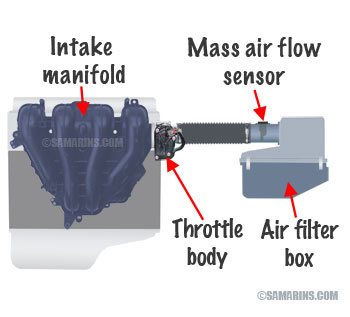 Engine air induction system diagram
In the fuel injection organization, the mass air flow sensor measures the air period into the engine. The engine computer (PCM) calculates how much fuel to inject based on the mass air menstruum sensor measurements.
If there is a vacuum leak anywhere betwixt the engine and the mass air period sensor, information technology causes "unmetered" air to enter the system. This causes the actual air flow to exist higher than the mass air flow sensor measures. As a result, the PCM miscalculates the corporeality of the injected fuel, and the engine runs "lean". The term "lean" means too much air and too little fuel. The result of a vacuum leak is more than noticeable at idle, when the air flow is lower.
Vacuum leak symptoms
Symptoms of a vacuum leak include the Bank check Engine light, crude idle, stalling and a hissing sound coming from the engine bay. The engine may run well at college RPMs, but surges, runs crude and struggles to maintain stable RPMs at idle. Often, the engine stalls when stopping. With a browse tool, one of the signs of a vacuum leak is the Long Term Fuel Trim (LTFT) going towards the plus (lean) side (e.g. over +15%) at idle, merely returning close to zip at higher RPMs. This is an indication that the engine runs lean at idle.
Mutual sources of vacuum leaks:
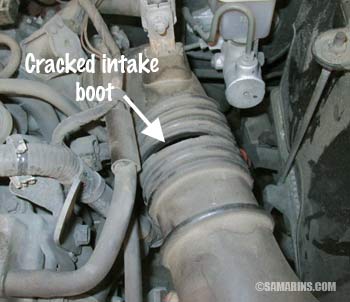 Cracked intake kick (snorkel)
Intake snorkel: A rubber or plastic duct or boot (snorkel) that connects the engine intake and the air filter box tin rip or crack. It's a very common trouble in older and high-mileage cars. The repair is easy, the rubber boot must be replaced. In most cars, it's secured by worm gear clamps at both ends. The role costs from $25 to $65. If an intake kick is not installed properly at an air filter box (run into this photograph) or at a throttle trunk, information technology tin can cause a vacuum leak besides.
Intake manifolds and gaskets: An intake manifold is bolted to the engine caput or plenum. With age, plastic intake manifolds warp.
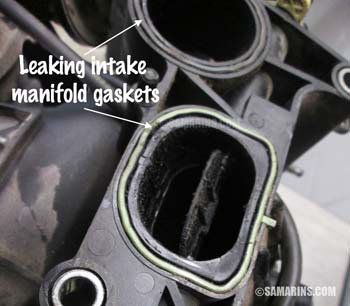 Leaking intake manifold gaskets
Gaskets and O-rings that seal the gaps harden and compress. This causes vacuum leaks. This problem is very common in many cars, including Ford, Toyota, Chrysler and GM cars. Plastic intake manifolds are peculiarly decumbent to leaks. Read more about the intake manifold.
To repair the trouble, leaking gaskets and O-rings must be replaced. Gaskets and O-rings are cheap, but removing the intake manifold requires a lot of work. The repair costs $twenty-$sixty for parts (gasket kit), plus $150-$450 labor.
In some cars, a plastic intake manifold can cleft, or ane of the fittings tin intermission off. For case, intake manifold cracks were adequately common in some older Ford engines. In this case, an intake manifold must exist replaced ($90-$320 part).
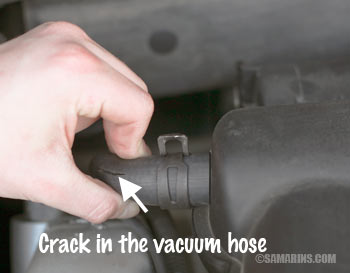 Cracked vacuum hose
Plastic and condom vacuum hoses and lines: With historic period, vacuum hoses go brittle and cleft or rip. The hoses and lines that connect the PCV organisation to the intake manifold are especially prone to failures. This happens because crankcase vapors incorporate oil, that damages the rubber or plastic, causing hoses and lines to swell and crevice. For example, the L-shaped safe elbows that connect to the intake manifold were common to fail in some Ford/Mazda cars. The repair is to supersede a croaky vacuum hose or line.
Positive Crankcase Ventilation or PCV system: The PCV system removes accident-by gases and oil vapors from the engine crankcase.
The PCV organisation collects the oil from vapors using an oil separator. Later that the vapors are directed into the engine intake through the PCV valve.
In many BMW, Volvo and other European models, the plastic and rubber parts of the PCV arrangement fissure and autumn apart at college mileage, creating vacuum leaks. In some GM cars, a PCV valve has a prophylactic diagram inside that is very common to fail. To repair the problem, failed parts must be replaced. Parts are not very expensive, merely in many cars the components of the PCV system are installed under the intake manifold. Removing an intake manifold is a labor-intensive task.
EGR Valve: The EGR system directs a small corporeality of exhaust gases into the intake to lower the combustion temperature. The EGR Valve connects the intake manifold to the exhaust system.
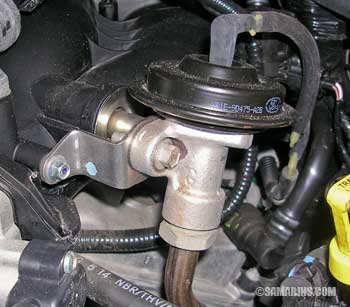 A stuck-open EGR valve can too produce a vacuum leak
Normally, it opens just when the automobile is driven steadily at higher speeds. Frequently, nonetheless, an EGR valve sticks due to carbon buildup. If an EGR valve is stuck open, it creates a vacuum leak, with the only difference existence that instead of air, it's the exhaust gases that enter the intake manifold.
A stuck-open EGR valve causes the same symptoms as vacuum leaks. Oft, problems with an EGR valve that is stuck open up are more noticeable afterward driving on the highway. For example, a car may stall when stopping after exiting the highway. A bad EGR valve must be replaced ($l-$320 part, plus $90-$320 labor). Read more: EGR valve: problems, symptoms, testing, replacement.
Brake booster: A brake booster is installed between the brake pedal and the brake master cylinder. In nearly cars, it'southward continued to the engine intake and is operated by the engine vacuum.
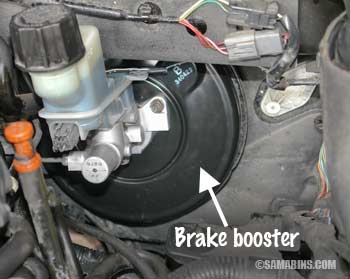 Brake booster is one of the possible sources of vacuum leaks
Within the brake booster, at that place is a vacuum diaphragm. When a brake booster leaks, it creates a vacuum leak. Symptoms of a leaking restriction booster include a hissing noise coming from the brake pedal area and lack of brake aid.
A leaking brake booster is a safety business and must be replaced. Several manufacturers take issued recalls or warranty extensions related to the brake booster. FCA (Chrysler) issued the recall R63 for some Dodge Dart models. There was also the recall P14 covering some 2011-2014 Dodge Durango and Jeep Thou Cherokee. Check for recalls at Safercar.gov. Several manufacturers offered warranty extensions. For instance, Mazda offered Warranty Extension Program SSP 93 for the brake booster units in the 2007-2013 CX-ix models. Your local dealer tin can check for this blazon of data.
Diagnosing vacuum leaks is not always easy. Mechanics use a browse tool, special spray, a vacuum approximate and other testing equipment. Often, to notice the source of a vacuum leak in the intake manifold, mechanics utilize a device chosen a smoke machine. A smoke machine produces vapor that looks similar fume. This vapor is introduced inside the intake manifold and a vacuum leak tin be spotted visually past vapor coming out in the area of the leak. If no equipment is available, another way is to look for common issues in your Brand, Model and Year. If your car has a vacuum leak, there is a adept gamble someone already had the same problem in the same car. Try, for example, searching YouTube or Google for 'Toyota Corolla 2005 common vacuum leak' and you will encounter people posting the repair information. In this auto (Corolla), the intake manifold is the common source of vacuum leaks. Nosotros also institute many YouTube videos on diagnosing vacuum leaks. Checking the technical service bulletins tin can also assistance. We posted several links where you can get access to a factory repair manual for a subscription fee in this article.
richardsonansts1975.blogspot.com
Source: https://www.samarins.com/glossary/vacuum-leaks.html
0 Response to "Will a Leaking Brake Booster Check Valve Cause a Change in Map Readings"
Enregistrer un commentaire